The Long History of Hidden and Secret Rooms
← Back to Blog
Aug 24, 2026

The long history of hidden and secret rooms

Long before "secret room" became a home-renovation search term, people were already building them, for reasons that had nothing to do with trend reports. Priest holes in Elizabethan England, prohibition-era speakeasies, and the aristocratic boudoirs of 18th-century France all did the same basic thing: gave someone a space that couldn't be found unless they wanted it to be. It's one of the oldest patterns in the history of hidden rooms, and the reasons changed by century. The impulse didn't.

Hidden for survival: the priest hole

Under Elizabeth I, practicing Catholicism was outlawed, and priests caught in England faced imprisonment, torture, and execution. Wealthy Catholic families responded by building "priest holes," concealed spaces tucked into fireplaces, staircases, and false walls, where a priest could hide, sometimes for days, while searchers tore the house apart looking for him. The most famous builder of these spaces was Nicholas Owen, who spent much of his life constructing more than twenty of them across the country before being captured and tortured to death in 1606, having never revealed a single hiding place. One of the most striking surviving examples, at Coughton Court, is a genuine double-blind: searchers who found the first hidden chamber, empty, had no idea a second, better-concealed space lay just beyond it. This wasn't decoration. It was architecture built entirely around the assumption that someone, at some point, would come looking.

Hidden for freedom: the speakeasy

Prohibition-era America produced its own version of the same instinct, minus the mortal stakes but with the same basic logic. When the sale of alcohol became illegal in 1920, speakeasies, illegal, secret bars operating outside the law, sprang up behind unmarked doors, false bookcases, and hidden entrances, with estimates for New York City alone ranging from twenty thousand to over a hundred thousand by the decade's end. These were rooms that had to look like something else entirely from the outside, precisely so the people inside could be exactly who they wanted to be. Many also became genuinely progressive spaces for their era, some of the only venues where people crossed lines of race, class, and sexuality that the world outside enforced strictly.

Hidden for pleasure: the boudoir

The word "boudoir," a lady's private sitting room or bedroom, comes from the French bouder, to sulk or pout, first used in the 1770s for a private room where a woman of the aristocracy could withdraw from the rest of the household entirely. What began as a small retreat off the bedroom, somewhere to be alone, evolved by the 19th century into something else: a room associated specifically with a different, more private kind of pleasure, one the rest of the house had no claim on. The boudoir's whole architectural point was that it answered to nobody's schedule but its owner's.

Hidden today: Berlin's own version

The same instinct runs straight through Berlin's contemporary club scene. In 2024, techno culture in Berlin was added to Germany's national inventory of intangible cultural heritage, recognized by the German UNESCO Commission. The city's clubs grew out of a post-Wall, queer-founded scene that needed real safety, and they built their culture around one governing idea: what happens inside is nobody else's business. Unmarked doors, notoriously opaque entry policies, no-photo rules, and consent-first private rooms aren't gatekeeping for its own sake. They're a direct descendant of the same logic that built a priest hole four centuries earlier, protecting what happens inside by controlling, completely, who gets to see it.
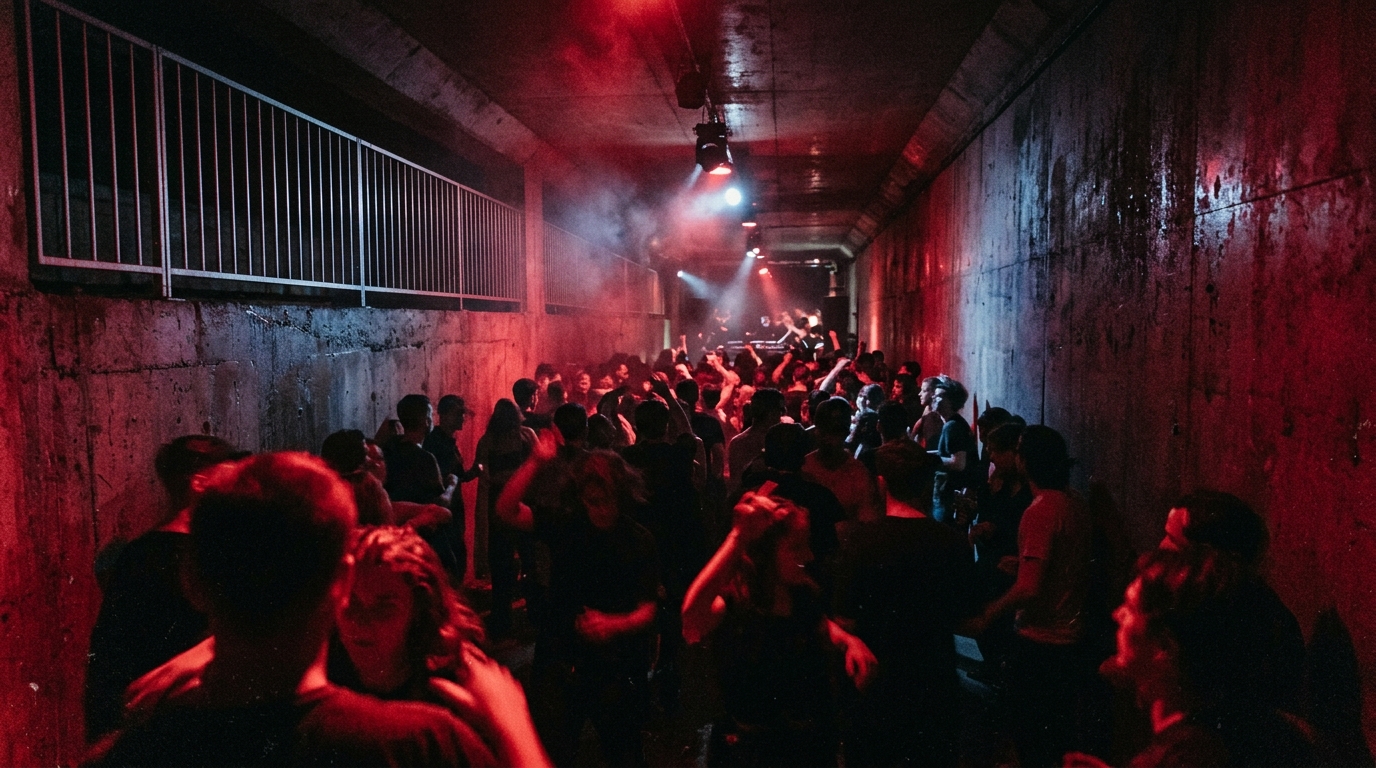
A crowded underground club scene in Berlin, echoing centuries of hidden and secret gathering spaces.

The instinct never actually went away

None of this is purely historical curiosity. Secret and concealed rooms are a genuine, active home design trend right now, not a novelty. Homes sold with a documented secret room have shown a meaningfully higher median sale price than comparable homes without one, and builders in the space report a real shift in why people ask for them: not for movie-style theatrics, but for practical, personal reasons, a home office, a wine room, a quiet space nobody else in the house needs to know about. As the president of one hidden-room design company put it, people are realizing these rooms aren't just for the movies, anyone can have one at home.

Same impulse, different century

A priest hole, a speakeasy, a boudoir, and a Berlin club all have almost nothing in common on the surface. What they share is the same underlying idea: a room that exists specifically so its use doesn't have to be explained, witnessed, or approved by anyone outside it. That's not a modern invention. It's one of the oldest reasons humans have ever built anything, which is really the answer to why people build secret spaces at all. The materials change. The reason for wanting the room, whether it's survival, defiance, or simple pleasure, changes with the century. The room itself, the one that answers to nobody but the person using it, has been the constant the entire time.

← Back to Blog

© 2026 Rooms for Desire. Blog - Process, projects, and the ideas that shape the rooms we build. Image Disclosure

×

Thank you!

We'll be in touch soon.

×

We'd love to hear from you.

Do you have questions for us or suggestions? Would you like to know more about our work and mission? Get in touch! We'll answer personally.

Please enter your name.
Please enter a valid email address.
Please check this box to continue.
I consent to the processing of my personal details and feedback. *
Stay in the loop. I agree to receive marketing newsletters and occasional email updates regarding the developments of "Rooms for Desire". I can opt out at any time by contacting hello@roomsfordesire.ch.

Your contact details and feedback are solely processed by us to respond to your inquiry, based on the consent you give above. Where you've opted in, we may also use anonymized, aggregate audience information to better understand who we're designing for. Your data is stored on secure Swiss servers (Infomaniak) and is never sold or shared. You may withdraw your consent at any time, without explanation. Full details on your privacy rights are available in the Privacy Policy.

×

Privacy Policy

Effective date: August 2026

We take the protection of your personal data very seriously. This privacy policy explains how we collect, process, store and protect your information when you interact with our website and submit feedback, in compliance with the Swiss Federal Act on Data Protection (nFADP) and, where applicable, the EU General Data Protection Regulation (GDPR).

1. Data controller

Eszter Nagy & Zuzanna Kotecka, Glärnischstrasse 4, 8307 Effretikon, Switzerland. Email: hello@roomsfordesire.ch

2. What information we collect and why

Contact details (name, email, phone if provided). Personal preferences (open-ended descriptions, feedback, preferences regarding custom-designed private spaces). Demographic/audience information (optional: age range, who the space is for, investment range, service preferences, where you spend time online). Technical metadata (IP, browser type, timestamp, collected by Infomaniak). We do not use third-party analytics; usage statistics are collected via self-hosted Matomo on our own Swiss servers, never shared externally.

Note: the blog's contact form collects a narrower set: name, email, and your message.

Special category data: some open-text fields may qualify as special category data under Article 9 GDPR / particularly sensitive data under the nFADP. No sensitive data is collected without your explicit consent, separate from general consent, and only to respond to your inquiry - same strict access controls apply. Purpose: evaluating and responding to your inquiry; aggregate demographic use to understand our audience, never sold/shared/disclosed. Newsletter opt-in: separate consent, withdrawable anytime. Legal basis: pre-contractual necessity (Art. 6(1)(b) GDPR / Art. 31 nFADP) for responding to inquiries; explicit consent (Art. 6(1)(a) GDPR) for marketing/aggregate use. No automated decision-making or profiling with legal/significant effects.

3. Data storage and security

Swiss hosting (Infomaniak). Access limited to Eszter and Zuzanna, MFA-protected. No sale/rent/trade/transfer to third parties. Breach notification: FDPIC and affected individuals notified without undue delay, per nFADP/GDPR 72-hour standard.

4. Strict data isolation and no big tech access

Sovereign Swiss infrastructure, isolated from foreign server networks and the US CLOUD Act. No Google/Meta/third-party access to databases or email. Form submissions and communications kept clear of third-party tracking, ad networks, and external cloud providers.

5. Data retention

Retained for the duration of engagement, or up to 24 months from last contact if no project moves forward, then deleted/anonymized. Deletion available anytime, no explanation needed.

6. Your data protection rights

Access, rectification, erasure, withdrawal of consent, data portability, lodge a complaint with the FDPIC/EDÖB. Exercise via hello@roomsfordesire.ch.

7. Cookies and similar technologies

Self-hosted Matomo analytics may set a first-party cookie to distinguish returning visitors and measure usage. No third-party advertising/tracking cookies; data never shared outside Swiss-hosted infrastructure. Consent requested before non-essential cookies; controllable via browser settings.

8. Children's privacy

Intended for adults; no knowing collection from anyone under 18. Prompt deletion on request if discovered.

9. Changes to this policy

Reserved right to update as the business or legal requirements evolve.

×

Image Disclosure

Images displayed on this blog are visualisations conceived and directed by our team, using AI tools to render and enhance the final images and videos. They serve only to accompany and illustrate each article's theme, and are not photographs of real spaces or client projects.